.
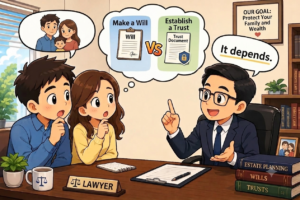
“Xiao Li is 45 years old and has 2 young children with her husband. Both she and her husband entered the workforce shortly after completing their secondary education. After more than 20 years of hard work, they have managed to accumulate a substantial amount of wealth and various assets in both Malaysia and Singapore.
.
As their family wealth grew, they began to seriously consider estate planning. Their greatest concern was this: if either one of them, or even both of them, were to suddenly pass away in an unexpected accident, would their children’s financial well-being and interests be adequately protected?
.
However, Xiao Li has always had one question in mind: Should they simply prepare a Will, or should they establish a Trust for their children?
.
She often hears her friends talk about “Trusts”, giving the impression that setting up a Trust is the only way to properly protect her family’s interests. But how exactly does a Trust work? Is it really better than a Will? And can a Will and a Trust be used together?”
.
In this article, we will explain in detail:-
.
✅ The key differences between a Will and a Trust;
✅ When a Will or Trust may be more appropriate;
✅ What types of assets can be dealt with through a Will or Trust; and
✅ Whether a Will and a Trust can be used together to provide more comprehensive estate planning.
.
📜If you are also considering how to properly plan for the future financial security of your family, read on:-
.
A. Key Differences Between a Will and a Trust
.
I. What is a Will?
.
A Will is a legal document that sets out how a person’s assets are to be distributed after his or her death. Apart from providing for the distribution of assets, a Will may also be used to express other wishes, such as appointing a guardian for minor children and setting out funeral or burial arrangements, etc
.
2. When does a Will take effect?
.
In Malaysia, a Will generally takes effect only upon the death of the testator. Until then, the assets remain fully owned and controlled by the testator.
.
This means that the testator is generally free to revoke or make a new Will during his or her lifetime as circumstances change — for example, when a beneficiary reaches adulthood or when one of the beneficiaries passes away.
.
3. What is a Trust?
.
A Trust is more closely related to the management and administration of assets. In simple terms, the owner of the assets, known as the Settlor, transfers or settles assets into a Trust to be held and managed by a Trustee in accordance with the terms of the Trust for the benefit of one or more Beneficiaries.
.
Unlike a Will, a Trust is not limited to the distribution of assets upon death. A Trust involves management of assets by a Trustee, it may also be used for various personal, family and commercial purposes.
.
4. When does a Trust take effect?
.
Unlike a Will, a Trust does not necessarily have to wait until the Settlor’s death to take effect.
Depending on its terms, a Trust may take effect immediately upon its establishment, or it may only come into operation upon the occurrence of a specified event.
.
5. Can a Trust be revoked or amended?
.
Another important difference is that a Trust may not always be freely amended or revoked by the Settlor.
.
For example, if the Settlor establishes an Irrevocable Trust, the relevant assets may no longer remain under the Settlor’s direct control after they have been transferred into the Trust. Instead, the Trustee will manage and administer those assets in accordance with the terms of the Trust for the benefit of the Beneficiaries.
Accordingly, whether a Trust can be amended or revoked will depend on the terms and nature of the Trust.
.
II. When Is a Will or Trust More Suitable?
.
6. When a Will may be more suitable
.
If a person simply wishes for his or her assets to be distributed to designated beneficiaries after death, a Will is generally the more straightforward and appropriate legal instrument.
.
7. When a Trust may be more suitable
.
On the other hand, if a person wishes for his or her assets to be managed by another person during his or her lifetime, particularly where the person may be unable or unwilling to manage the assets personally, a Trust may be more suitable.
.
Common situations include:
A) Long-term residence or employment overseas
A person who lives or works overseas for an extended period may find it difficult to personally manage Malaysian properties, investments or other assets. In such circumstances, a Trustee may be appointed to manage the assets, including collecting rental income and dealing with related administrative matters.
.
B) Anticipating a future loss of capacity
A person may be concerned that, due to dementia, Alzheimer’s disease or other circumstances affecting his or her capacity, he or she may eventually become unable to manage financial affairs.
.
By establishing a Trust in advance, arrangements can be made for a Trustee to take over the management of the assets when necessary and to use those assets for the Settlor’s living and other expenses.
.
C) Substantial or complicated assets
A Trust may also be suitable where a person owns numerous or substantial assets, has a more complicated family structure, or wishes to preserve part of his or her wealth for a particular long-term purpose.
.
Examples include providing for a disabled family member, making charitable donations, or setting aside assets for religious or other specific purposes.
.
In such cases, a professional Trustee may manage and distribute the assets in accordance with predetermined terms over an extended period.
.
III. Can a Will and Trust Be Used Together?
8. Yes.
In fact, in many circumstances, a Will and a Trust are not mutually exclusive. They can be used together as part of a more comprehensive estate planning strategy.
.
9. Testamentary Trust
.
For example, if the beneficiaries are still young, a testator may include a Testamentary Trust in his or her Will.
.
A Testamentary Trust only comes into effect after the testator’s death. The assets forming part of the estate can then be managed by the appointed Trustee until the children reach a specified age or satisfy certain conditions, at which point the assets may be transferred to them.
.
This type of arrangement may be particularly useful where:
.
- the family circumstances are complicated, such as in cases involving remarriage or concerns regarding the relationship between different family members;
- there is a concern that both parents may pass away at the same time;
- there is concern that a surviving spouse may remarry and may not necessarily prioritise the interests of children from the previous marriage; or
- the parents do not want their children to receive a substantial inheritance in one lump sum while they are still relatively young.
.
10. Greater control over how the inheritance is managed
.
Through a Testamentary Trust, the testator can provide more detailed instructions regarding how the inheritance is to be managed and used.
.
For example, the Will may provide for:
.
- the appointment of a guardian for minor children;
- the appointment of a person to manage the inheritance before the children reach adulthood;
- circumstances in which certain assets may be sold or utilised for emergency purposes;
- the amount of monthly allowance or education expenses that may be paid to the children;
- the children receiving full control of the inheritance only when they reach a specified age, such as 25 or 30; and
- certain major financial decisions requiring the consent or approval of specified persons.
.
This allows the testator to exercise greater control over how the inheritance is preserved and utilised, rather than simply transferring a large sum of money or assets to a young beneficiary all at once.
.
11. In simple terms
.
In simple terms, a Will primarily determines “who will inherit the assets”, while a Trust goes a step further by determining “how the assets should be managed and used before, or while, they are ultimately received by the beneficiary.”
.
Using both a Will and a Trust together may therefore provide greater flexibility in estate planning and better protect the long-term interests of minor children and other family members.
.
12. A well-known example
.
A well-known example is the late Hong Kong entertainer Shum Din Ha (沈殿霞), who passed away in 2008.
.
It was reported that she had made arrangements through her Will to establish a Testamentary Trust for her daughter, who was only 21 years old at the time. The arrangement was intended to ensure that her daughter would not receive and control the entire inheritance at such a young age.
.
Under the reported arrangement, her daughter would only be entitled to receive full control of the inheritance when she reached the age of 35.
.
This illustrates how a Testamentary Trust can be used to protect a young beneficiary from receiving a substantial inheritance before he or she is considered sufficiently mature to manage it responsibly.
.
IV What Assets Can Be Dealt With Through a Will or Trust?
.
13. A wide range of assets may potentially be dealt with through a Will, a Trust or a Testamentary Trust, depending on the nature of the asset and the applicable legal requirements. These may include:
.
- cash and bank deposits;
- shares and bonds;
- real estate;
- certain insurance policies or policy benefits;
- retirement savings;
- artwork and collectibles;
- motor vehicles; and
- jewellery and other valuable personal belongings.
.
14. However, not every asset will necessarily pass in the same manner. Certain assets may be subject to specific laws, contractual arrangements, nominations, joint ownership arrangements or other legal restrictions.
.
15. There is therefore no absolute rule as to which assets should be dealt with through a Will and which should be placed into a Trust. The more important considerations are the nature of the assets, the family circumstances, and most importantly, when and how the person wishes the assets to be transferred, managed and ultimately enjoyed by the beneficiaries.
.
16. For this reason, estate planning should not simply focus on whether a person should “have a Will” or “set up a Trust”. Instead, the appropriate structure should be considered based on the person’s assets, family circumstances and long-term objectives. A properly structured estate plan may involve a Will, a Trust, a Testamentary Trust, or a combination of these arrangements.
.
📲 This concludes our sharing on Wills and Trusts in Malaysia. We hope this article has provided you with a better understanding of the key differences between a Will and a Trust, and how both may be used as part of an estate planning strategy. If you would like to learn more about Wills, Trusts or estate planning, please feel free to contact us via WhatsApp: https://wa.link/q3kmv5
.
❤️ Like & Follow our Facebook page to receive more legal updates.
.
🌐 You may also visit our website to learn about other areas of law:
https://www.yeolaw.my/
.
#yeolawchambers #ylc #jblawyer #willdrafting #estateinheritance #estateplanning #trust #testamentarytrust #杨律师事务所 #华人律师 #法律 #立遗嘱 #遗产规划 #马来西亚遗产继承