.
“To make a will, you would need at least one executor. Who do you want to appoint as your executor???”
.
When appointing lawyer to prepare a will, many people will encounter their lawyers asking this question.
.
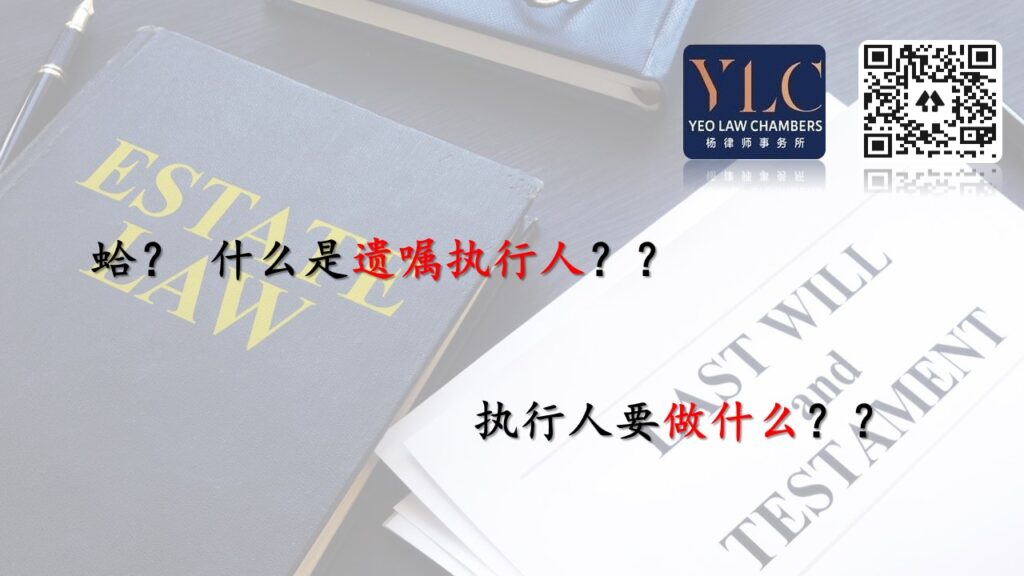
So, what is an executor?
.
After a person dies, what are the duties of his/her executor? What needs to be done (by the executor) legally?
.
Can he/she give up being the executor?
.
Question 1: What is an executor?
.
Before delving into the responsibilities of an executor, first we will explain what an executor is.
.
According to Section 2 of the Probate and Administration Act 1959, an executor is defined as
.
“A person to whom the execution of the last will of a deceased person is, by the testator’s appointment, confided and includes a person deemed to be appointed executor as respects settled land”
.
Simply put, an executor is a person appointed by the testator, with main duty is to execute the contents of a will. Although the law does not put down specific requirement(s) as to who can or cannot be an executor (except that he must be an adult). However, it is basically more recommendable to find someone who is relatively younger, trustworthy and capable to become an executor.
.
Question 2: What are the duties of the executor?
.
Basically, an executor has 4 types of responsibilities:
.
FIRST, gathering all the necessary documents, and to identify all the parties involved in a will
.
When a person dies testate, his/her executor would need to locate the original will and identifying all parties involved such as the beneficiaries and witnesses, as well as the properties left by the deceased and debts (such as loan, card debt etc).
.
SECOND, appointing solicitors
.
After collecting all the documents/ information, the executor will need to appoint a lawyer to apply for a Grant of Probate from the High Court. The purpose of applying probate is to let the Court recognizes the contents of the will and its legality.
.
After obtained the Grant of Probate, the identity of the executor will be legally recognized. The Probate issued by the Court is also required to effect the transfer (from testator to beneficiaries) in the procedure later.
.
THIRD, settling debt (from the estate of the deceased)
.
After a person dies, his debt will not automatically wipe out or becomes invalid.
.
According to Section 68 of the Probate and Administration Act 1959, one of the most important duties of the executor is to repay debts, including funeral expenses, legal fee incurred for obtaining grant of probate, loans, credit card debts, income tax, etc.
.
If the deceased’s estate does not consist enough cash to settle his debt, then the executor can exercise his power to sell the deceased’s properties to repay these debts.
.
LASTLY, distributing the assets of the Deceased
.
After all debts are dealt with, the executor can proceed to distribute the deceased’s estate to the beneficiaries according to the will. If the executor does not understand the contents of the will, he can seek the assistance from his lawyer.
.
In addition, it is recommendable for the executor open a special account to manage the deceased’s estate (ie to receive payment sand distribute the movable assets), or prepare a statement of account to keep all the necessary transaction records so as to avoid unnecessary dispute in the future.
.
Question 3: Can an executor resign or renounce his rights?
.
If the executor died earlier than the testator or in a situation where the executor is unwilling to cooperate, an application can be made to the High Court to appoint a new administrator in substituting the executor. The court order is known as Letters of Administration with Will annexed. The procedure will be more complicated and costly.
.
These are some information regarding roles of an executor that we would want to share with you today. If you have any inquiries about it, please do contact us: https://wa.link/q3kmv5
.
Further, If you want to know the procedures for applying Grant of Probate, you can read our article
.
If you want to know the procedures for applying Letters of Administration, you can read our article
.
About the importance of having a will, you can read our article
.
Like & Follow our Facebook Page to get more legal information.
.
You can learn other legal information from our website:https://www.yeolaw.my/
.
#YeoLawChambers #YLC #Grantofprobate #letterofadministationwithwillannexxed #遗嘱认证书 #estatedistribution #willdrafting #准备遗嘱 #JBlawfirm #Bandardatoonn #法律